
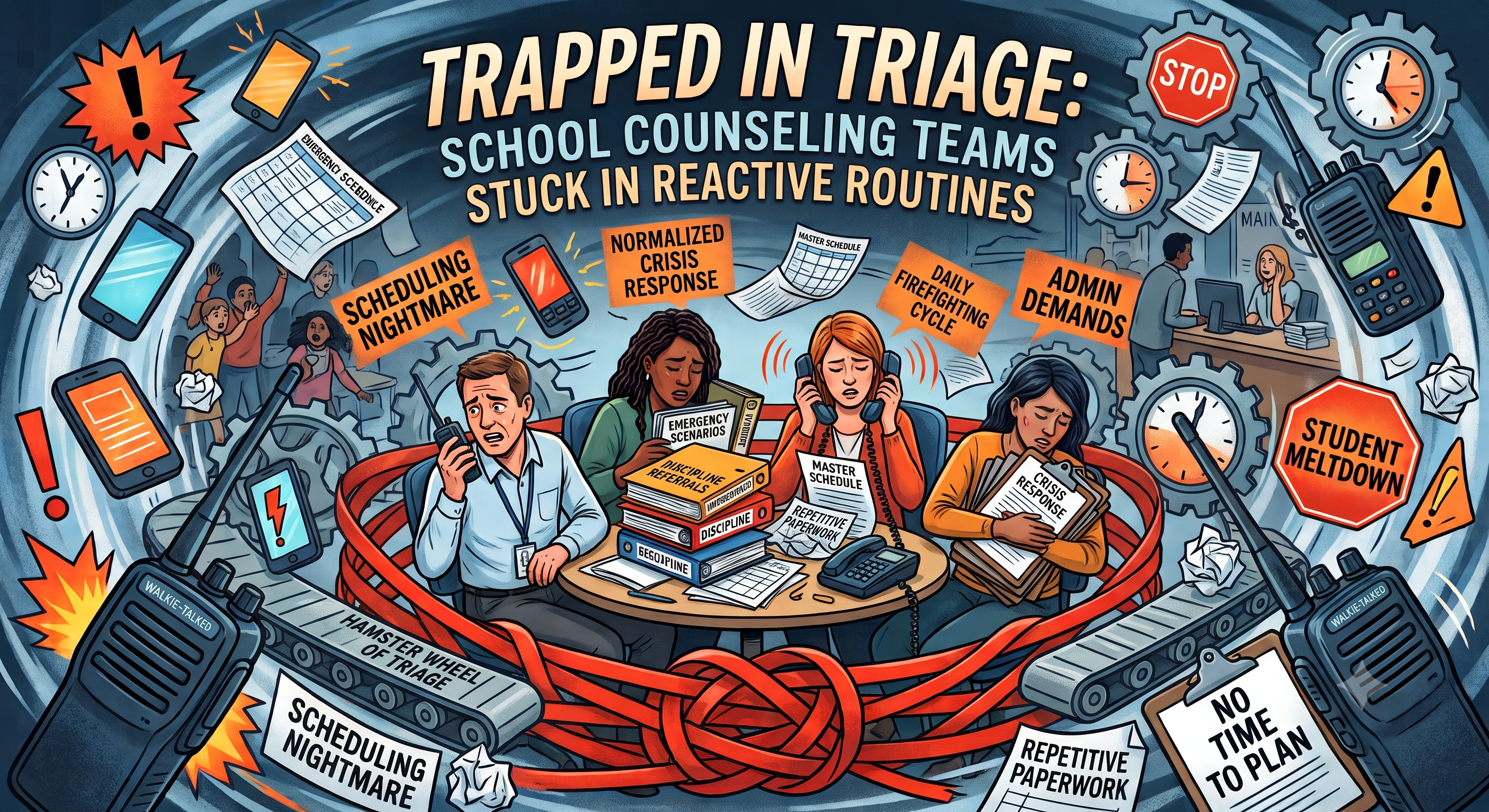
In public education, we often judge the value of a system by how it responds to an emergency. When a student experiences an acute crisis in the hallway, when peer conflict erupts in the cafeteria, or when enrollment errors threaten a student’s graduation path, the school counselor has historically been the first professional called to solve a problem.
But when a school counseling program is entirely reactive, it operates like an underfunded fire department: constantly putting out blazes rather than establishing systems designed to prevent emergencies (Rayle & Adams, 2007).
To truly maximize the graduate-level training and educational expertise of school counselors, K–12 systems must intentionally pivot from a reactive, crisis-response model to a proactive, systemic framework. When we treat counselors as leaders rather than emergency responders, we shift student support from a damage-control lens to one of universal prevention.
The Evidence: Why a Proactive Counseling Team Wins
The push for proactive school counseling is not simply an idealistic preference; it is an evidence-based necessity heavily supported by educational research and multi-tiered frameworks (Frank et al, 2025). At the heart of this proactive shift is the implementation of a Comprehensive School Counseling Program (CSCP).
The Rationale for a CSCP
Historically, school counseling operated under a position-focused model, in which the counselor’s role was defined by a set of reactive tasks, clerical duties, and crisis interventions. In contrast, a CSCP shifts to a program-focused model. A CSCP is an intentional, data-driven framework designed to ensure that every student, not just those who visit the office in crisis, receives systematic support across three core domains: academic development, career readiness, and social-emotional growth (Martin & Carey, 2014).
The rationale for creating a CSCP is rooted in equity and predictability. When a counseling program is structured comprehensively, it aligns directly with the school’s academic mission. It is created by assessing school-wide data (such as attendance, behavior referrals, and achievement gaps), establishing measurable student goals, and delivering a planned curriculum. Rather than waiting for systemic failures to manifest in individual students, a CSCP builds the scaffolding necessary to prevent those failures from occurring in the first place.
The Data-Backed Impact of the Program-Focused Model
According to the American School Counselor Association (ASCA) National Model, which serves as the blueprint for a CSCP, school counselors should spend at least 80% of their time delivering direct and indirect services to students (Olsen et al, 2023). When districts invest in creating a formal CSCP that frees counselors to deliver a universal Tier 1 core curriculum, such as teaching self-regulation, executive functioning, and interpersonal skills. The benefits of the CSCP are measurable in several ways:
- Dramatically Lower Crisis Volume: Integrating a CSCP within a Multi-Tiered System of Supports (MTSS) builds students’ coping strategies early. Consequently, high-risk Tier 2 and Tier 3 behavior crises decrease significantly because students have already acquired foundational self-regulation skills through the program.
- Improved Academic Outcomes: State-level evaluations of comprehensive school counseling programs have revealed that schools with highly implemented, programmatic counseling frameworks see significant positive correlations with student outcomes. In Nebraska, researchers found higher student achievement and fewer disciplinary problems, while in Utah, a robust CSCP orientation was associated with higher average ACT scores and broader college interest (Martin & Carey, 2014).
- Increased Equity and Access: Historically, students in less affluent school districts with higher rates of racial and ethnic diversity have faced limited access to school counselors due to high ratios and administrative overload (Hilts et al., 2025). A data-driven CSCP ensures that college and career readiness planning reaches every student via structured, proactive scheduling, serving as a powerful driver of educational equity.
The Two Paradigms: A Comparative Look
How school counselors spend their hours is the single greatest predictor of their program’s systemic impact (Olsen et al, 2023). The distinction between reactive and proactive counseling is not just a difference in daily tasks; it represents two fundamentally opposing educational philosophies.

The High Cost of Counselors Caught in the Middle
While educational literature neatly divides counseling into reactive and proactive categories, the boots-on-the-ground reality for most practitioners is far more complex. Thousands of school counselors find themselves painfully caught in the middle: they are fiercely committed to proactive, preventative care, yet they are structurally tethered to a reactive system.
This creates an exhausting double shift. A counselor might spend their morning preparing a Tier 1 classroom guidance lesson on emotion regulation or organizing Tier 2 small groups for chronically absent students. But on the way to the classroom, a radio call about an active crisis halts their plans. The Tier 1 lesson is postponed, the Tier 2 group is canceled, and the counselor is pulled back into firefighter mode. Later that evening, to ensure their students don’t miss out on supportive resources, those same counselors stay late to reschedule lessons, analyze data, and draft small-group content.
This constant whiplash of trying to build a preventative foundation while simultaneously absorbing every shockwave in the building can lead to severe professional fatigue:
- The Fragmentation of Services: When proactive Tier 1 and Tier 2 initiatives are repeatedly interrupted by Tier 3 emergencies, preventive programming loses consistency and, consequently, its effectiveness (Olsen et al, 2023).
- Role Confusion and Guilt: Counselors caught in this trap often experience a double-edged guilt. They feel they aren’t responding quickly enough to immediate building crises, while also feeling they are failing their general student population by canceling scheduled lessons.
- Rapid Burnout: Operating in a state of perpetual triage while trying to execute a proactive counseling program is structurally unsustainable. It relies on highly trained, master’s-level educators as systemic band-aids rather than as strategic leaders.
To solve this, we must recognize that a counselor’s schedule cannot be so flexible as to be disintegrating. True advocacy means moving away from expecting counselors to heroically balance both on their own, and instead putting boundaries in place that protect preventative instructional time.
The Weight of the System: When the Problem is Bigger Than the Counselor
It is vital to acknowledge a truth that many advocacy models gloss over: sometimes, the system is simply heavier than the individual.
We know that school counselors do not exist in a vacuum. You can have the most robust, data-driven, ASCA-aligned plans on paper, but if you are operating with a 1:600 student caseload, in a district facing severe staffing shortages, or under an administration that views counseling purely as clerical support and testing coordination, the systemic obstacles are larger than you.
When you are structurally forced into a reactive protocol day after day, it is easy to feel a sense of professional defeat. You might ask: Why even try to plan Tier 1 lessons or pull Tier 2 groups when they are only going to be disrupted? Why fight a battle against a culture that refuses to change?
But here is why the effort, no matter how small or compromised, still matters:
- Micro-Shifts Build Macro-Change: You do not have to overhaul your entire school’s culture by next Monday. Shifting to a proactive model can start with a single, protected 30-minute block once a week. It can look like running one targeted small group for five students struggling with executive functioning. These micro-successes provide the very data you need to show your administration, “Look at what happened to these five students when we intervened early. Imagine what we could do for fifty.”
- Proactivity is an Act of Self-Preservation: Every time you successfully teach a coping strategy or emotional regulation tool to a classroom or small group, you are proactively reducing the future queue outside your office door. Even if you only reduce crises by 5% this semester, that is 5% more breathing room for you and your students.
- Refusing to Normalize the Chaos: When we stop trying to be proactive, we inadvertently signal to our systems that the reactive, firefighter model is acceptable. Continuing to plan, advocate, and collect time-use data (even when it feels like shouting into the wind) keeps the professional standard high. It ensures that when opportunities for systemic change arise, you already have the framework in place.
If you are struggling to make the shift, give yourself grace. You cannot single-handedly fix a systemic crisis. But by protecting whatever small pockets of proactive work you can, you are keeping the true promise of the school counseling profession alive. One student, one lesson, and one small group at a time.
Dismantling the Barriers to Proactive Advocacy
If the benefits of proactive counseling are so overwhelming, why does the reactive firefighting model remain the default in so many school buildings?
The answer lies in systemic inertia. High student-to-counselor caseloads, administrative misunderstanding of the counselor’s role, and historical precedents of assigning clerical duties to counseling staff keep highly trained professionals locked in a cycle of administrative maintenance (Brown & Knight, 2025; Olsen et al, 2023).
Transitioning to a proactive model requires bold advocacy. School counselors must be empowered to partner with school administrators, sharing time-use data and demonstrating how systemic programming aligns directly with the school’s overall academic and behavioral goals.
The Advocacy Toolkit: Overcoming Common Pushback
When advocating for a proactive school counseling model, counselors frequently encounter resistance from well-meaning administrators who are trying to manage immediate building needs.
Below are three common pushback scenarios and evidence-based, collaborative rebuttals designed to reframe the conversation around student outcomes.
1. The “Immediate Needs” Objection
Pushback: “But what about the crises happening right now? I need you in the hallway and on call. We don’t have time to worry about classroom lessons when kids are actively melting down in the main office.”
- The Proactive Rebuttal:
“I completely agree that student crises require urgent, professional support. However, relying solely on reactive crisis intervention is like trying to empty an overflowing sink with a teacup while leaving the tap running. When we deliver universal, proactive Tier 1 lessons on self-regulation, coping strategies, and conflict resolution, we are closing that tap. If we dedicate 80% of our time to systemic preventive programs, we will reduce the overall volume of behavioral crises over time (Olsen et al., 2023). Investing in prevention now is the only sustainable way to make our school calmer and safer for everyone.”
2. The “Administrative Coverage” Objection
Pushback: “We are short-staffed. I need you to coordinate standardized testing, cover 504 plan compliance paperwork, and manage master scheduling. If you don’t do it, who will?”
- The Proactive Rebuttal:
“I understand how incredibly tight our staffing is, and I want to support our building’s administrative success. However, using a master’s-level mental health professional to manage logistical and clerical tasks is an inefficient use of school resources and directly impacts student mental health. When my schedule is consumed by compliance paperwork and test coordination, we lose hundreds of hours of direct, clinical student contact (Dunn, 2025). By delegating non-counseling tasks to administrative support staff, we can reallocate my time to run data-driven, small-group interventions targeting chronic absenteeism and academic failure—areas that directly impact our school’s performance metrics.”
3. The “Instructional Time” Objection
Pushback: “Teachers are already stressed and can’t afford to lose instructional time for you to do classroom counseling lessons. Every minute of class time must be focused on math and reading.”
- The Proactive Rebuttal:
“Our teachers are under immense academic pressure, and protecting their instructional time is a priority. However, students cannot learn academic content when they are dysregulated, anxious, or actively in conflict with their peers. A student who is chronically absent or constantly sent out of the room due to behavior issues is already losing valuable instructional time (Hilts et al., 2025). My proactive, 30-minute classroom lessons are designed to teach students executive functioning, emotional regulation, and academic perseverance. Ultimately, a classroom of emotionally regulated, focused students actually gives teachers more uninterrupted instructional time, not less.”
A Direct Message to District Leadership and Decision-Makers
To the superintendents, school board members, executive directors, and senior administrators reading this: the structural crisis impacting school counselors is directly impacting your student outcomes.
Many dedicated leaders are simply unaware of the daily operational realities inside their counseling departments. When you look at a school counselor, you may see a flexible staff member capable of filling gaps, scheduling standardized testing, managing 504 compliance paperwork, covering open classrooms, or sitting in the main office to handle behavioral fallouts. But when you treat school counselors as logistical catch-alls, you are unintentionally defunding your own mental health and academic support systems.
We urge you to look closely at your district’s data and ask a fundamental question: Are we budgeting for highly trained, master’s-level educators only to use them as high-priced administrative clerks?
When our youth are facing unprecedented rates of anxiety, depression, and chronic absenteeism, continuing a reactive firefighter model of school counseling is an expensive, ineffective utilization of talent.
Shifting Your Expectations: From Containment to Strategy
We need district leadership to boldly shift their perspectives and expectations in three distinct ways:
- Redefine “Success” From the Top: Stop measuring a counseling department’s effectiveness solely by how quickly it de-escalates a crisis in the hallway. Instead, evaluate them on the systemic health of their CSCP. Ask your counselors for their data on Tier 1 services, achievement gap closing, and proactive small-group interventions.
- Audit and Protect Counselor Time: Mandate time-use tools across your district to ensure counselors meet the ASCA-recommended 80% threshold for direct and indirect student services. If an audit reveals that your counselors are spending 40% of their year coordinating testing or entering scheduling data, commit to reallocating those clerical duties to support staff.
- Fund the Ratios, Protect the Framework: High-implementation CSCPs require manageable caseloads. When you vote on district budgets and staffing allocations, remember that lowering student-to-counselor ratios isn’t just a workforce luxury; it is a direct investment in preventative student care and educational equity.
The choice to move from a reactive school culture to a proactive one cannot rest solely on the shoulders of an individual counselor pushing back in a building-level meeting. It requires systemic permission, political will, and structural protection from the highest levels of leadership.
Conclusion: A Call to Educational Leaders
To advocate for proactive school counseling is to advocate for educational equity and systemic health. When school leaders protect the role of the school counselor, they are investing in a sustainable foundation of student support.
Let us stop waiting for students to fail before we offer them our expertise. Let us build schools where every child is equipped with the social, emotional, and academic skills to thrive long before a crisis ever begins.
References
Brown, C. H., & Knight, D. (2025). Student-to-school counselor ratios: Understanding the history and ethics behind professional staffing recommendations and realities in the United States. Ethics & Behavior, 35(3), 221-239.
Dunn, K. H. (2025). An Examination of the Relationship Between School Counselors’ Use of Time, Student Perceptions of School Counselors, and Students’ College, Career, and Life Readiness in Indiana Schools (Doctoral dissertation, Indiana State University).
Frank, A., DeDiego, A. C., Farrell, I. C., Jones, K., & Tracy, A. C. (2025). School Counseling Roles Across States: A Content Analysis Using the ASCA National Model. Professional Counselor, 15(2).
Hilts, D., Liu, Y., & Guo, X. (2025). An investigation of student outcomes based on student-to-school counselor ratios. Counseling Scholarship & Practice in Educational Communities, 1(1).
Martin, I., & Carey, J. (2014). Development of a Logic Model to Guide Evaluations of the ASCA National Model for School Counseling Programs. Professional Counselor, 4(5), 455-466.
Olsen, J., Parikh Foxx, S., Flowers, C., & Hayakawa, K. (2023). An analysis of school counselors’ time spent on ASCA aligned activities. Journal of Counseling Research and Practice, 8(1), 8.
Rayle, A. D., & Adams, J. R. (2007). An Exploration of 21st Century School Counselors’ Daily Work Activities. Journal of School Counseling, 5(8), n8.
Leave a Reply