
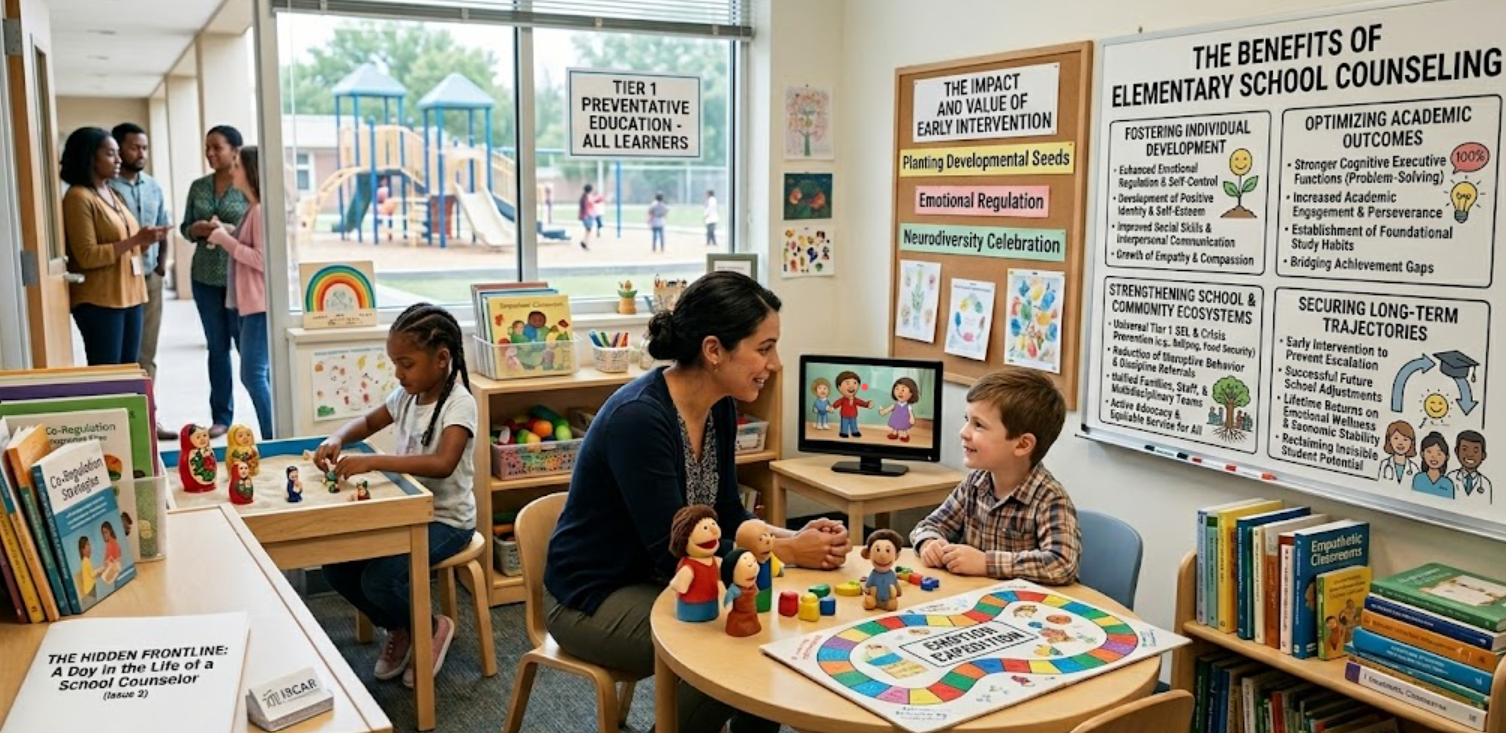
Issue 2: The Impact and Value of Early Intervention with Elementary School Counselors
Executive Summary
Elementary schools are vibrant spaces of discovery, connection, and foundational growth where children first develop their unique voices, social identities, and love for learning. Extensive educational research consistently demonstrates that early, counselor-led intervention provides the essential bedrock for lifelong emotional regulation, enhanced classroom performance, and positive long-term school adjustment (Blair & Raver, 2015; Sink & Stroh, 2003). Yet, despite these clear developmental benefits, a systemic disconnect frequently persists between established research and daily educational practice. This issue of The Hidden Frontline explores the lived experiences of practicing elementary school counselors across diverse geographic and socioeconomic regions—ranging from high-poverty, urban Title I centers to large suburban districts—celebrating their profound, life-changing impact as they foster emotional safety, confidence, and a deep sense of belonging for our youngest learners.
The findings from interviews with elementary school counselors reveal a unique, powerful duality. When allowed to operate fully within their professional scope, these educators employ highly specialized, creative methodologies to achieve profound breakthroughs for their students. These triumphs are visible every day when a counselor successfully helps a child transform a reactive behavioral track into self-regulated success, guides a student from sensory overload to peaceful co-regulation, untangles playground anxieties, or instills a building-wide culture that celebrates neurodiversity.
At the same time, counselors frequently navigate a subtle systemic friction often driven by a simple lack of role understanding and visibility. Because the most transformative aspects of a counselor’s work occur through confidential student interactions or quiet, preventative interventions, well-meaning colleagues and instructional staff are not always aware of the depth of the counseling impact. This can lead to unintended assumptions that counselors have open schedules or are not fully occupied with student care. This baseline misunderstanding frequently results in a cycle of role displacement, where these specialized professionals are stretched thin across non-counseling logistical duties or pressured to reduce deeply qualitative, confidential human connections into rigid, compliance-heavy metrics.
This document serves as both an uplifting celebration of the vital, foundational role of elementary counselors and an encouraging, actionable guide for school boards, superintendents, and building principals. To optimize school climate, elevate student achievement, and ensure long-term institutional efficacy, educational leadership must actively preserve, support, and continue to clarify the professional scope of the elementary school counselor.
A Note of Gratitude: Our Contributors
This white paper would not be possible without the profound vulnerability, dedication, and insight of the practicing school counselors who shared their stories. We extend our deepest gratitude to the educators whose lived experiences form the narrative content of this document. To honor their professional vulnerability and ensure their safety in the field, all identifying markers have been completely de-identified in accordance with our strict protocols for anonymity.
- Counselor 1 brings a seasoned wealth of expertise to this narrative, having built a dual foundation as both a certified school counselor and a certified classroom teacher across varied school settings over the last two decades.
- Counselor 2 offers a deep, specialized perspective, with extensive experience integrating relational-cultural frameworks and developmental play strategies in high-need, Title I school communities, while also serving as a district mentor for newly hired school counselors.
- Counselor 3 is a vibrantly dedicated educator with a rich background in classroom teaching before transitioning to school counseling, bringing specialized expertise in supporting neurodivergent student populations, designing behavioral social contracts, and championing building-level equity.
The Value of Early Intervention
A central theme across the interviews conducted is the unique, foundational nature of elementary school counseling. Unlike secondary counselors, whose impact is often highly visible through immediate quantitative metrics such as graduation rates and college placements, elementary counselors serve as the first point of contact for a child’s psychological and emotional baseline within the educational system. Rigorous peer-reviewed research confirms that proactive elementary counseling programs yield significant long-term returns, positively altering a student’s developmental trajectory by embedding essential behavioral and academic foundations early in life (Carey & Dimmitt, 2012; Reback, 2010). Practitioners frequently describe this vital, behind-the-scenes labor as the essential work that quietly shapes a student’s long-term educational success. As Counselor 1 highlights, elementary counselors are the ones planting the fundamental developmental seeds that assist with students’ future academic success.
When allowed to operate within their proper professional scope, these specialists deploy advanced developmental counseling strategies uniquely tailored to early childhood development. For instance, Counselor 2 routinely uses play-based strategies and relational-cultural approaches to help young students process trauma and develop self-regulation skills through an age-appropriate medium. This practitioner-led approach aligns with extensive school counseling literature demonstrating that child-centered play and relational strategies delivered within the school building significantly decrease disruptive behaviors, improve classroom engagement, and scaffold long-term emotional regulation (Ray et al., 2015). Counselor 2’s program tracking mirrors these empirical findings, demonstrating a measurable, documented decrease in the necessity for behavioral limit-setting as students progress through consistent, play-focused interventions over a multi-week span.
Furthermore, innovative counselors integrate creative media and behavioral frameworks into their practice to make abstract emotional concepts tangible for young minds. Counselor 3 has successfully bypassed traditional, rigid disciplinary tracks by designing student-led “social movies” focused on inclusion and utilizing puppets to represent characters in her curriculum. By bringing these puppets into classrooms, Counselor 3 explicitly teaches emotional literacy, navigates online bullying, and cultivates building-wide empathy for neurodivergent populations. Academic research strongly validates these creative media modalities, confirming that externalized storytelling and puppet-based interventions contribute significantly to the development of socio-emotional abilities, emotional expressiveness, and empathy among early childhood and elementary populations (Carter & Mason, 1998; Pitre et al., 2007). These tools give students a safe psychological distance to process complex interpersonal dynamics and build horizontal peer accountability.
Through Tier 1 preventative education, counselors deliver proactive classroom lessons focused on dynamic coping skills, bullying prevention, and safety, ensuring every child receives a universal baseline of support. Contemporary school counseling research underscores that robust Tier 1 social-emotional learning (SEL) programs not only reduce building-wide behavioral infractions but also optimize the overall instructional climate for all students (Goodman-Scott et al., 2023). This holistic advocacy frequently extends beyond the classroom walls; Counselor 2 has successfully spearheaded structural, community-level initiatives ranging from establishing formal school therapy dog policies to constructing a community school garden and reinforcing neighborhood food security. This systemic outreach aligns with ecological school counseling frameworks, which emphasize that sustainable student success occurs when counselors actively bridge gaps among the school, the family, and the surrounding community (Bryan & Henry, 2012).
For elementary school leaders, funding and protecting these early childhood counseling positions is not merely a supportive measure; it is a vital strategic investment. By intervening proactively at the front end, elementary counselors prevent behavioral crises from escalating, preserve critical instructional time for teachers, and build the foundational wellness required for long-term academic excellence.
Outcomes of Elementary School Counseling
Elementary school counselors are systemic multipliers. When they are empowered to lead with their expertise, they set off a powerful ripple effect throughout the building. They do not just perform isolated tasks; by directly equipping students with foundational life skills, counselors structurally fortify the classroom, lift heavy burdens from teachers, and significantly reduce daily operational strain for administrators. This systemic transformation begins at the individual level, where counselors serve as the primary interpreters of student distress.
1. Translating Behavior into Direct Instructional Time
Young children at times express emotional distress, anxiety, or sensory overload through their behavior because they lack the advanced vocabulary to explain what is wrong. Elementary school counselors act as vital developmental translators within the school building. Instead of meeting a child’s behavioral escalation with immediate, reactive punishment, counselors step in with empathy and specialized strategies to uncover the root cause.
For instance, Counselor 3 regularly encounters students facing intense behavioral hurdles. By using proactive tools such as developmental limit-setting and creative emotional-literacy media, the school counselor guides children to safely identify their emotions, helping them transition from sensory overload to calm co-regulation while ensuring their unique neurodivergent differences are celebrated.
This developmental attunement bridges critical communication gaps between educators and students. When counselors share these insights with teachers, classroom management naturally shifts from a stressful, reactive posture to a proactive, trauma-informed framework. Counselor 2 notes that when teachers witness these profound breakthroughs, their perspective shifts from a defensive stance to active collaboration, eagerly partnering with the counselor to pull vulnerable students whenever needed. This seamless partnership significantly reduces classroom disruptions, maximizes direct instructional time, and prevents vulnerable children from being prematurely pushed into disciplinary tracks (Amatea et al., 2004). By stabilizing these individual crises on the front end, counselors lay the groundwork for building broader, student-led systems of accountability across the entire campus.
2. Cultivating Connection and Student Accountability
Beyond individual interventions, counselors excel at creating safe, structured micro-environments, such as targeted lunch groups, peer mediation sessions, and intentional play groups, where students safely practice positive social behaviors and navigate peer friction. These spaces have become increasingly vital as young students grapple with the intense social anxieties stemming from early exposure to digital media. Counselor 1 notes that fourth- and fifth-graders frequently bring overwhelming digital drama from home into the school day. Left unaddressed, weekend online conflicts can completely hijack a Monday morning, but counselors step in immediately to help untangle the social fractures before they disrupt classroom learning.
To sustain this positive climate, counselors implement collaborative behavioral social contracts that give students tangible ownership of their choices. Counselor 3 noted the success in utilizing these collaborative contracts to unite the student, parent, and teacher around shared behavioral goals. By integrating a student’s personal strengths and favorite developmental anchors into the agreement, the framework incentivizes positive choices over time. The impact of this relational approach is remarkably enduring; Counselor 3 notes that students frequently internalize these strategies so deeply that they seek out the counselor in later grades to voluntarily renew their contracts to manage any new behavioral impulses.
This specialized skill set builds a healthy culture of horizontal peer accountability. Implementing targeted small-group counseling and conflict resolution noticeably shrinks the volume of daily administrative discipline referrals, allowing principals to focus on building leadership rather than daily behavior management (Schellenberg et al., 2007). Fostering this level of accountability naturally extends beyond the school walls, requiring counselors to weave the surrounding community into the student support network.
3. Unifying Families and School Support Teams
Elementary counselors serve as the central heart of a school’s support system, connecting families, staff, and community resources. They possess an exceptional capacity for taking complex educational frameworks or intimidating legal jargon and translating them into warm, empowering language for families who feel overwhelmed. Counselor 2 explicitly uses her role to advocate for parents, ensuring they understand their educational rights. When severe district understaffing left classrooms short-handed, Counselor 2 provided families with the exact administrative phrasing and terminology needed to firmly and successfully request the support services their children were legally promised.
This dedicated advocacy transforms a school building into a highly cohesive, multidisciplinary machine. By organizing and leading weekly collaboration meetings among school nurses, social workers, case managers, and external partners, counselors ensure that student care is never siloed or redundant. Counselor 2 emphasizes that despite deep neighborhood needs, this multidisciplinary synergy allows her team to function as a beautifully synchronized unit, securely connecting families to nurse practitioners, mental health partnerships, and stabilizing community resources.

Educational research strongly supports this systemic outreach, proving that school counselors are the essential catalysts who maximize the efficiency, funding, and impact of school-community support networks (Bryan & Holcomb-McCoy, 2007). For district leaders, protecting and investing in the counseling role is the single most effective way to turn a school building into a trusted, stabilizing anchor for the entire community.
Systemic Role Misalignment in Practice
Despite the profound efficacy of early interventions, elementary school counselors frequently report a gradual erosion of their professional identity. Systemic role misalignment occurs when administrative leadership fails to fully comprehend the specialized scope of modern school counseling, subsequently treating these certified professionals as generic operational resources or administrative assistants. When the lines of the profession become blurred, the structural foundation of support begins to fracture, heavily impacting the school culture and services provided to students.
The Quantitative vs. Qualitative Misalignment
A primary driver of professional burnout is the continuous systemic pressure to justify a deeply qualitative, confidential profession through rigid, compliance-driven quantitative data. For budgetary and fiscal purposes, school districts increasingly demand that counseling programs mirror classroom instructional metrics, expecting counselors to anchor their professional value strictly to hard metrics like attendance percentages or immediate fluctuations in standardized test scores.
As Counselor 3 candidly points out, school districts frequently attempt to evaluate counseling using quantitative tools, whereas counseling is fundamentally qualitative, confidential, and highly individualized profession. Forcing an organic, therapeutic alliance into rigid numerical boxes completely misinterprets how human growth and relationship development occurs. Peer-reviewed literature confirms that evaluating school counselors using frameworks designed for classroom teachers significantly increases role ambiguity, diminishes job satisfaction, and mismeasures actual counseling efficacy (Cervoni & DeLucia-Waack, 2011).
Furthermore, counselors report that administrators frequently treat them as punitive behavioral managers rather than developmental supports, demanding that they “fix” children who are navigating acute personal crises. Counselor 3 notes the immense friction this causes with building leadership who lack training in incremental child development milestones.
A Milestone Redefined: When administrators demand an immediate, permanent cessation of a behavior, they often fail to recognize massive systemic successes, such as a severely traumatized student safely reducing their classroom elopement frequency from a daily occurrence to just twice a week.
To counter this evaluation gap, effective school counseling practitioners maintain personal program-tracking spreadsheets to monitor student trends, systemic interventions, and incremental behavioral progress. By documenting their impact through thorough, self-collected field data, counselors preserve records of student breakthrough that top-down bureaucracy often overlooks because of its qualitative nature. Proactively capturing these hidden victories becomes nearly impossible when a counselor’s daily schedule is co-opted by administrative logistics.
Role Ambiguity: The Assignment of Non-Counseling Duties
When school buildings face intense staffing shortages or operational strain, counselors are routinely displaced from direct student services to compensate for a lack of building-level logistical tasks. In severe cases across the country, some counselors report that up to 80% of their instructional day is completely consumed by administrator-assigned, non-counseling operational duties. While national professional models dictate that a counselor’s proper scope of practice must focus on direct student care, preventive small-group guidance, and school-wide behavioral regulation, the operational reality on the ground is marked by significant systemic displacement.
Counselor 1 details how she is expected to serve as the primary coordinator and proctor for high-stakes state standardized testing. This heavy administrative burden locks them into testing rooms for a few weeks each school year, completely halting their counseling schedule and leaving students who experience acute emotional distress during testing without any immediate counselor availability. This pattern of using highly trained mental health advocates as logistical gap-fillers creates a disparity in student support, a reality felt during the implementation of specialized student accommodation plans.

The 504 Plan Conflict: Compliance vs. Collaboration
In some districts, elementary counselors are given the sole responsibility of managing, writing, and monitoring compliance-heavy 504 accommodation plans. Counselor 1 expresses deep discomfort with this arrangement, explaining that serving as a 504 case manager legally requires them to monitor and enforce compliance among their teaching peers. As documented by researchers Goodman-Scott and Boulden (2020), tasking a school counselor with 504 case coordination introduces a severe, systemic conflict of interest.
Because school counselors lack administrative or supervisory authority over building staff, expecting them to address co-workers who are not fulfilling a student’s 504 plan expectations places the counselor in an untenable “policing” role. Confronting a teaching peer over a lack of classroom compliance transforms the counselor from a supportive, horizontal collaborator into an unwanted building enforcer. This dynamic completely erodes the professional trust and horizontal relationship required for healthy counselor-teacher collaboration. Instead of viewing the counselor as a safe partner to consult with regarding vulnerable students, teachers may adopt a defensive posture, ultimately undermining the cohesive team environment necessary to serve children effectively. This fracture in school-level collaboration frequently mirrors larger institutional barriers that introduce organizational vulnerabilities.
Institutional Barriers and Liability Risks: Ignoring Counselor Expertise
This fracturing of building-level collaboration is particularly dangerous given the escalating mental health challenges arriving in elementary school hallways every single day. While suicide and acute self-harm behaviors were historically viewed strictly as adolescent issues, contemporary public health data reveals a tragic shift toward younger demographics.
The Changing Landscape of Student Safety:
- Tripled Rates: Data compiled by the Centers for Disease Control and Prevention (CDC) shows that the suicide rate for children aged 10 to 14 tripled between 2007 and 2018, remaining painfully elevated over subsequent years (CDC, 2023).
- Annual Preteen Increases: A landmark study published in JAMA Network Open found that suicide rates among preteens aged 8 to 12 have been increasing by a staggering 8.2% annually since 2008, with the highest overall rates observed among Black youth and the sharpest rate of increase appearing among female preteens (Ruch et al., 2024).
Despite the immense, high-stakes reality of this youth mental health crisis, districts frequently double down on bureaucratic roadblocks by mandating that school counselors utilize rigid, risk-stratification tools. These policies require counselors to assess and classify a student’s suicide risk into strict “low, medium, or high” tiers during a moment of acute crisis. Counselor 1 notes that multiple counselors in their district have aggressively pushed back against these mandates, citing the American School Counselor Association (ASCA) ethical guidelines.

Dr. Carolyn Stone (2021), a leading national expert on educational legal and ethical issues, explicitly warns that forcing school counselors to predict child safety using numerical stratification scales is inaccurate, dangerous, and legally reckless. Decades of research demonstrate that risk-scoring models possess no true predictive value, yield dangerously high false-negative rates, and can deeply mislead parents if an elementary student is incorrectly labeled as a “low-risk” case (Stone, 2021).
To better protect student safety and minimize institutional liability, school districts must actively listen to national standards and move away from risk-stratification scales, transitioning instead to standard response-based models. As advocated by ASCA and national research, response-based models focus entirely on an immediate, protocol-driven protective approach:
- Gathering contextual behavioral information about the student’s distress without attempting to medically diagnose or calculate mathematical lethality.
- Notifying parents or guardians immediately, transparently, and universally regarding any expressions of suicidal ideation.
- Providing families with comprehensive community mental health resources, accompanied by explicit legal disclaimers that an in-school screening cannot guarantee future safety.
The cost of ignoring the evidence-based research is a profound disservice to students, families, and the surrounding community. When school boards and central office administrators erect bureaucratic roadblocks against these safer, standards-aligned screening formats, they do a grave disservice by completely failing to leverage the expertise of the school counselors who navigate these crises on the ground every day. To mitigate severe liability and elevate student care, educational leadership must actively listen to, trust, and implement the direct feedback of their school counseling staff. Districts must utilize established research in counselor education and make systemic policy improvements based on data that has been rigorously tested and validated by national governing bodies.

Failing to honor the field-tested insights and everyday experiences of practicing school counselors is a massive institutional oversight. When districts ignore their counselors’ voices in favor of rigid, outdated compliance protocols, they do not just increase their legal vulnerability; they systematically compromise the safety of the children who walk through their school doors.
Strategic Recommendations for Systemic Change
To disrupt this cycle of role erosion, maximize student success, and protect school districts from liability, the Institute for School Counseling Advocacy & Research (ISCAR) outlines the following recommendations for school leaders:
1. Mandate Role-Specific Evaluation Tools
Districts must immediately cease evaluating school counselors using generic, non-certified, or instructional-staff teaching rubrics. Evaluating specialized professionals with mismatched metrics is an institutional failure that increases role ambiguity. Counselors must be evaluated by qualified personnel utilizing rubrics explicitly aligned with national counseling models, measuring systemic program implementation, crisis intervention, and student outcomes rather than classroom instructional data.
2. Enforce the 80/20 Time Rule and Remove Administrative Logistics
In alignment with national professional standards, school leadership must actively protect counselors’ schedules to ensure that at least 80% of their time is dedicated to direct and indirect student services. Administrative and logistical burdens, specifically state standardized testing coordination and administrative 504 case supervision, must be structurally reassigned to administrative or clerical staff to reclaim the counselor’s time for direct intervention.
3. Fund Comprehensive Support Teams and Address Resource Equity
To prevent the school counselor from becoming the sole catch-all for every medical, legal, and social need, district leaders must commit to funding integrated support teams. High-need buildings must be staffed with a cohesive, synchronized unit: a School Nurse, a Social Worker, a School Counselor, and a Family Specialist. This multidisciplinary department organization maximizes operational efficiency and ensures student needs are never addressed in isolation.
4. Transition to Response-Based Crisis Models
To significantly reduce district liability and align with expert-vetted best practices, school boards must update their crisis and suicide-prevention protocols. Districts should retire outdated risk-stratification frameworks and adopt standard, response-based screening models, protecting both the student in crisis and the school counselor’s professional scope.
5. Structurally Separate Counseling from Discipline
Administrators must safeguard the counseling office as a strictly non-punitive, restorative environment. Forcing counselors to execute disciplinary actions, administer punishments, or behave as holding-cell monitors fundamentally breaks the counselor-student alliance, destroys student trust, and closes the avenue for proactive self-referral during mental health crises.
Conclusion
Elementary school counselors are not operational filler, nor are they a luxury designed for administrative convenience. They are highly trained educational, behavioral, and developmental advocates whose daily, specialized work dictates the long-term psychological stability and academic trajectory of our youngest students. To continue utilizing these professionals as logistical generalists, compliance enforcers, or high-stakes testing coordinators is a profound misallocation of professional resources that directly compromises student safety, academic growth, and district compliance. In an era marked by an unprecedented and tragic surge in pediatric and preteen mental health crises, professional role clarity is no longer an idealized preference, it is a mandatory protective barrier for our schools.
By implementing the strategic recommendations outlined by the Institute for School Counseling Advocacy & Research (ISCAR), reforming mismatched evaluation rubrics, strictly enforcing the 80/20 time rule, reassigning 504 case management, and adopting response-based crisis protocols, district leaders do not simply optimize their building operations. They actively fortify their classrooms, insulate their districts from severe legal liability, and establish a profound safety net for vulnerable children.
Advocacy cannot exist without truth, and the unfiltered experiences shared by our practitioners reveal that the status quo is unsustainable. It is necessary that school boards, superintendents, and building principals to step into this leadership vacuum, honor the specialized expertise of their counseling staff, and protect the quiet, vital work of planting the seeds for our children’s future.
References
Amatea, E. S., Daniels, H., Bringman, N., & Vandiver, F. (2004). Strengthening counselor-teacher-family connections: The design and evaluation of a developmental teacher consultation model. Professional School Counseling, 7(4), 216–226.
Blair, C., & Raver, C. C. (2015). School readiness and self-regulation: A developmental psychobiological approach. Annual Review of Psychology, 66(1), 711–731. https://doi.org/10.1146/annurev-psych-010814-015221
Bryan, J., & Henry, L. (2012). A model for building school-family-community partnerships: Principles and process. Journal of Counseling & Development, 90(4), 408–420.
Bryan, J., & Holcomb-McCoy, C. (2007). An examination of school counselor involvement in school-family-community partnerships. Professional School Counseling, 10(5), 441–454.
Carey, J., & Dimmitt, C. (2012). School counseling and student outcomes: Summary of six statewide studies. Professional School Counseling, 16(2), 146–153.
Carter, R. B., & Mason, P. S. (1998). The selection and use of puppets in counseling. Professional School Counseling, 1(5), 50-53.
Centers for Disease Control and Prevention. (2023). Suicide and homicide death rates among youth and young adults aged 10–24: United States, 2001–2021 (NCHS Data Brief No. 471). National Center for Health Statistics.
Cervoni, A., & DeLucia-Waack, J. (2011). Role conflict and ambiguity as predictors of job satisfaction in high school counselors. Journal of School Counseling, 9(1).
Goodman-Scott, E., & Boulden, R. (2020). School counselors’ experiences with the Section 504 process:“I want to be a strong team member…[not] a case manager”. Professional School Counseling, 23(1), 2156759X20919378.
Goodman-Scott, E., Betters-Bubon, J., Donohue, P., & Olsen, J. A. (Eds.). (2023). The school counselor’s guide to multi-tiered systems of support. Routledge.
Pitre, N., Stewart, S., Adams, S., Bedard, T., & Landry, S. (2007). The use of puppets with elementary school children in reducing stigmatizing attitudes towards mental illness. Journal of Mental Health, 16(3), 415-429.
Ray, D. C., Armstrong, S. A., Balkin, R. S., & Jayne, K. M. (2015). Child‐centered play therapy in the schools: Review and meta‐analysis. Psychology in the Schools, 52(2), 107-123.
Reback, R. (2010). Schools’ mental health services and young children’s emotions, behavior, and learning. Journal of Policy Analysis and Management, 29(4), 698-725.
Ruch, D. A., Horowitz, L. M., Hughes, J. L., Sarkisian, K., Luby, J. L., Fontanella, C. A., & Bridge, J. A. (2024). Suicide in US preteens aged 8 to 12 years, 2001 to 2022. JAMA network open, 7(7).
Schellenberg, R. C., Parks-Savage, A., & Rehfuss, M. (2007). Reducing levels of elementary school violence with peer mediation. Professional school counseling, 10(5), 2156759X0701000504.
Sink, C. A., & Stroh, H. R. (2003). Raising achievement test scores of early elementary school students through comprehensive school counseling programs. Professional School Counseling, 6(5), 350-364.
Stone, C. (2021). Suicide assessments: The medical profession affirms school counselors’ truth. ASCA School Counselor, 58(6), 12–17.
Leave a Reply